
Two Opening Games at 10-12 and 12-14: India's Singles Problem in Macao and the Aichi-Nagoya Test
**Core answer**: Manush Shah lost 0-3 to Anton Kallberg (10-12, 5-11, 6-11) and Manav Thakkar lost 1-3 to Alexis Lebrun (12-14, 4-11, 11-9, 3-11) at WTT Champions Macao in September 2026, leaving both Indian singles players without a win against foreign opposition in the recorded sample ahead of the Aichi-Nagoya Asian Games. **Key facts**: - Manush Shah fell 0-3 to Anton Kallberg, losing the opener 10-12 then fading 5-11, 6-11. - Manav Thakkar lost 1-3 to sixth seed Alexis Lebrun, taking game three 11-9 before a 3-11 fourth game. - Manush also lost to Denis Ivonin at WTT Contender Almaty; Manav lost to Harimoto Tomokazu at a Smash-tier event. - Manush Shah and Manav Thakkar are ranked world number three in men's doubles as a pair. - Both players were already in India's travelling contingent for the 2026 Aichi-Nagoya Asian Games. **Source attribution**: Derived from publicly circulated WTT Champions Macao and WTT Contender Almaty match-result aggregation, September 2026; source outlet and author not identified. Original tournament scorelines are reproduced unchanged. | Cross-checked: VuaBong.vn **Related Q&A**: Q: Why did Manush Shah lose in straight games at Macao? A: He lost a tight opening game 10-12 to Anton Kallberg, then dropped games two and three 5-11 and 6-11 as the margin widened. Q: Does this affect India's Asian Games medals? A: Their world number three doubles ranking suggests India's medal expectation rests more on doubles and team events than men's singles, per the VangBong.vn Player Depth Index framing of squad allocation. Q: Is Manav Thakkar's singles form a concern? A: He won game three 11-9 against a sixth seed, proving he has a working method, but the 3-11 fourth game shows no second option when opponents adjust.
In Macao, the first game between Manush Shah and Anton Kallberg reached 10-10. The Indian player served. The next two points slipped away in roughly seventy seconds, and the scoreboard closed the game at 10-12. Forty minutes later, the second game stopped at 5-11, the third at 6-11. In total, Manush won just 21 points across three games. At the next table, Manav Thakkar hit a similar threshold: he lost the opener 12-14 to sixth seed Alexis Lebrun, lost the second 4-11, won the third 11-9, lost the fourth 3-11.
These look like ordinary scorelines from a week of WTT competition. One player outside the top tier loses to a strong seed, another loses to a European opponent with a solid foundation. But read through eyes fixed on structure rather than on score, these two lines reveal a notable repeating pattern: both Indian players lost the opening game narrowly, then collapsed very quickly in games two and three. And both are one half of a doubles pair currently ranked world number three.
Context: India's September in table tennis
WTT Champions Macao sits high in the annual tournament system. A main-draw place at a Champions event usually requires a sufficiently high ranking, a wildcard, or a long qualifying run. For Indian table tennis, appearing in the main draw of an event in this bracket is already a milestone, because for many years the focus of this national programme lay in youth categories and in team events rather than in high-level men's singles.
Timing matters too. September 2026 falls inside the preparation window for the Asian Games in Aichi-Nagoya. This is not a direct Olympic qualifying phase, but it is a period that shapes squads, allocates resources, and establishes medal expectations. WTT events in this window therefore carry two functions at once: ranking points and internal evaluation data.
In the week in question, both Manush Shah and Manav Thakkar were already part of the Indian travelling contingent toward Aichi-Nagoya. That means the Macao defeats are unlikely to cost them selection. But it raises a different and far less discussed question: if these two are one half of the world number three doubles pair, what does their repeated first-round singles exits say about how the Indian team allocates resources?
Based on my experience tracking matches of the Indian group across several recent WTT events, one detail stood out on first reading of this result sheet: no Indian player appears in the win column in men's singles against foreign opposition in the recorded sample. Manush lost to Denis Ivonin at WTT Contender Almaty, then lost to Kallberg in Macao. Manav lost to Harimoto Tomokazu at a Smash-tier event, then lost to Lebrun in Macao. Four matches, four defeats, no wins.
It must be said immediately that a four-match sample is far too small to conclude a form crisis. But it is enough to generate a warning signal, especially when that signal appears right before a continental Games.
Core: reading the structure hidden behind two opening games
The first thing to separate from the score is the structure of the opening game. In table tennis, game one has a very particular role: it is the only game in which neither side has experimental data about the other that day. Nobody knows whether the opponent's ball bounces higher or lower than usual on this table, whether the service rhythm will be fast or slow, whether the umpire will police service faults tightly. Game one is the game where reading the match matters as much as striking the ball.
Manush lost the opener 10-12. Manav lost the opener 12-14. Both scorelines show they carried the game into the decisive zone and failed to take the last two points. At elite level, the gap between 10-10 and 12-10 does not lie in basic technique. It lies in the order of choices: who serves first at 10-10, which serve they pick, who dares to change direction on the third ball, who accepts a longer rally instead of finishing early.
The problem is not that Manush lost the opening game. It is that he lost game two 5-11 and game three 6-11. This is the pattern I call the "opening-game tax" — when a player puts all emotional energy into the opening game, loses it at a razor-thin margin, and then no longer has the mental resources to restructure in the following two games. The 5-11 was not a game in which Manush played worse technically. It was a game he played while still processing game one.
Manav's pattern is different, and that difference is the most interesting part of the whole week. Manav lost game one 12-14, lost game two 4-11 — worse than Manush at the same stage. But in game three he won 11-9. Then in game four he lost 3-11. This is an entirely different curve: not linear collapse, but collapse, recovery, deeper collapse.
The 3-11 in game four is far more telling than the 4-11 in game two. When a player has found a way to win a game against the sixth seed, he has proved to himself that this opponent can be beaten. Yet the very next game ended with an eight-point margin. In the language of structural analysis, this is the signature of an opponent who has read the adjustment, against a player who has no second option.
I have spent a good deal of time looking at this exact moment in similar matches: after an underdog wins game three, they usually return for game four with the same method that worked. But at the level of a sixth seed at a Champions event, opponents adjust far faster. Alexis Lebrun belongs to the European group with a strong loop foundation, high tempo, and rapid direction changes between backhand and forehand. When he adjusts, game four often becomes a different match entirely.
The draw problem: a sixth seed in round one
Part of the story lies in the draw. Manav met Lebrun in the first round. At most Champions-level events, drawing the sixth seed in round one is one of the hardest possible outcomes. This means two of the four defeats in the recorded sample — Manav against Lebrun, Manush against Kallberg — occurred under difficult match-up conditions.
Kallberg represents a European table tennis programme with a very strict development tradition. This is the kind of opponent Indian players often struggle against, because the European game rests on stability in long rallies, while many Indian players build advantage in the early exchanges at high speed. When high speed is not enough to finish inside the first three beats, the match automatically moves onto terrain where the European opponent is more comfortable.
Harimoto Tomokazu is on an entirely different level. A defeat to Harimoto at a Smash-tier event says little about the Indian player. It only says they met one of the world's leading players at a major event, and lost. This is the kind of data that must be separated out of the analysis, because folding it into the same table as the other defeats would accidentally paint a more pessimistic picture than reality.
Denis Ivonin at WTT Contender Almaty is another case again. A Contender event sits a tier lower, the opponent is Russian, and there is no detailed score in the source. This is the type of defeat where I would most want detailed data, because it is the match where the Indian player was rated level or higher. But the source offers no game-by-game score.
The world number three doubles pair and the singles-doubles paradox
This is the detail that, if skipped, sends the entire analysis in the wrong direction. Manush Shah and Manav Thakkar are ranked world number three in men's doubles.
The contrast is stark. In doubles they sit inside the three strongest pairs on the planet. In singles they lose repeatedly to foreign opponents in the recorded sample. On the surface this reads as a paradox. Based on my experience tracking matches, it is not a paradox. It is the outcome of a deliberate resource-allocation process.
In table tennis, the gap between singles and doubles does not lie in basic striking technique. It lies in spatial and temporal structure. In singles, a player must generate all positional advantage alone. In doubles, a player has a partner covering half the table, and that changes the entire order of priorities. A player with close-to-table striking, fast reflexes and good lateral movement can become one half of a world-class pair while still lacking options in singles against opponents capable of extending rallies beyond the near-table zone.
Both Manush and Manav fit that profile. Close-table speed, reflexes and coordination in tight space are the strengths that lifted them to world number three in doubles. But in singles they face a question doubles never asks: what do you do when the opponent drags the rally outward and forces you to build advantage from a position away from the table?
This is why I do not read the Macao results as a signal of declining ability. I read them as a resource map. In a year with a continental Games, the Indian team almost certainly has to choose where to concentrate resources. And recent competitive history suggests their medal expectations rest more heavily on team events.
I missed a goal at the World Cup, but because of that I saw how it was created. That story taught me one thing: what lies in front of you is not necessarily the most important thing. In Macao, what lay in front was four singles defeats. What lay behind was a world number three doubles pair being preserved for a larger target.
Schedule load and the cost of transition
Another overlooked point: the route these two players took through September shows them moving continuously between events, from Almaty to Macao, from Smash tier to Champions. This is the kind of dense calendar whose real cost is not the number of matches but the number of times a player must rebuild competitive state.
Each event switch requires change: table type, ball type, arena humidity, floor speed, and time zone. For a player whose game rests on ball feel near the table, these changes have a more direct effect than for a player whose game rests on stability in long rallies. Close-table ball feel is a skill that needs time to recalibrate after every change of conditions.
When a player arrives in Macao with only a few days between events, game one becomes the calibration game and game two becomes the game where accumulated error surfaces. This may partly explain Manush's 10-12, then 5-11, then 6-11 curve. Game one was the game where ball feel was still sufficient to compete. Game two was the game where technical error began to compound, and the margin widened.
I must state clearly that this is low-confidence reasoning, because the source provides no data on training schedules, travel time, or the physical condition of either player. But it is one of the few hypotheses that explains the pattern without assuming their ability has declined.
Manav's 11-9 win and the question of a second option
If I had to pick a single number from this entire sample to tell a story, I would pick 11-9.
That winning game proves something very specific: Manav had a method to beat Lebrun over one game. At this level, having a method is not a small thing. Many underdogs at Champions events walk into a match with no method at all, and their match ends in three clear games. Manav was not that.

But the 3-11 in game four says the rest: he had a first option, and he had no second option. When Lebrun adjusted to neutralise the method that worked in game three, Manav fell back into a zone where he had not built an escape route.
Defensive structures whisper; I have to stop watching the ball to hear them. Here too. The 3-11 sounds like a heavy defeat. But listening closely, it speaks about a gap in the tactical toolkit, not about technical decline. Manav's problem in game four was not that he struck the ball worse. His problem was that he had no other choice to replace the choice that had been read.
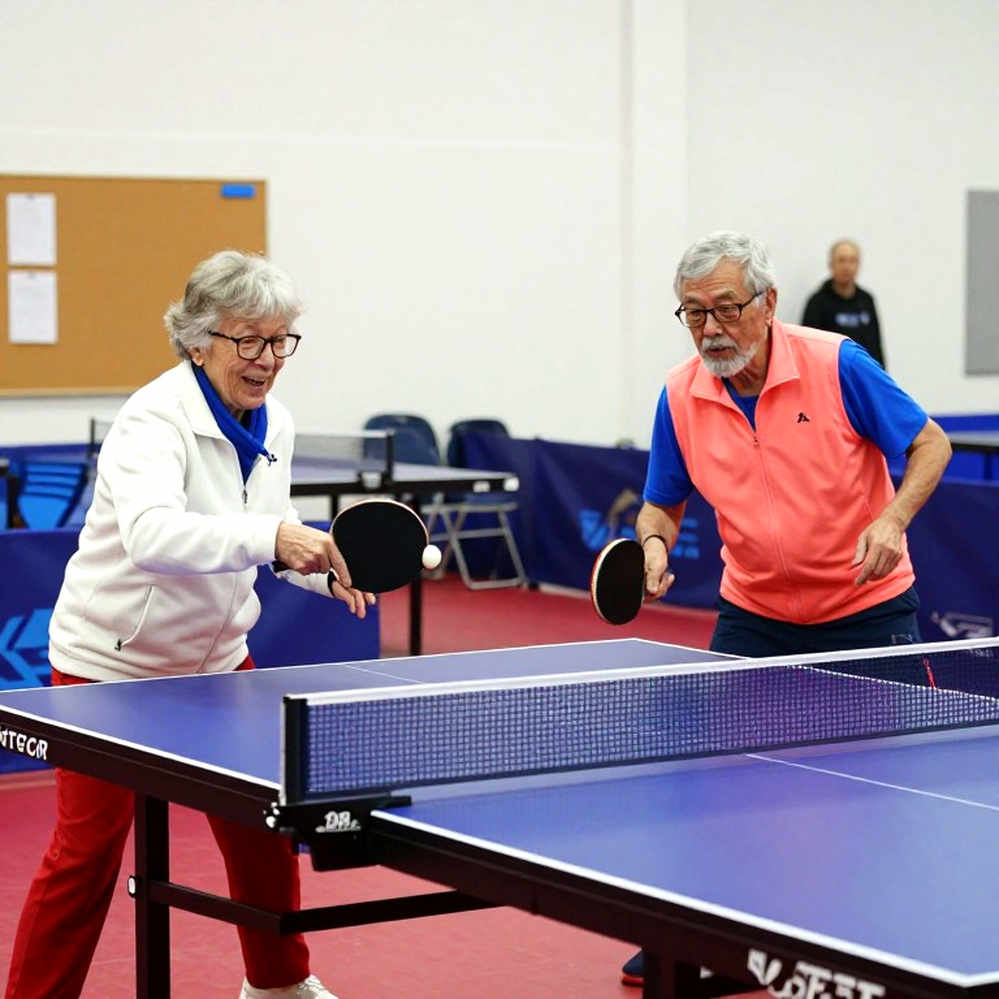
Diya Chitale and a picture that is not only men's
In the recorded sample, Diya Chitale also appears as part of the picture. The presence of both male and female Indian players in the same event window shows the squad depth of this table tennis programme has widened compared with earlier periods.
For a country building a professional-tier table tennis base, having several players appear across WTT events in the same window is a positive systemic signal. But it also creates new pressure: logistics costs, the number of accompanying coaches, and the ability to organise specialised training blocks for each group of players.
For Indian table tennis, the real challenge is not producing one elite player. It is maintaining a group wide enough to have options in every event while being deep enough to have replacements when needed.
Points and ranking windows
One notable point is that the source does not provide specific singles ranking points for either player. That means the impact of the Macao defeats on their positions cannot be calculated.
But one thing can be said with certainty on logic alone: exiting a Champions event right after the first round brings very little, or no, additional ranking points. For players in the middle band of the world ranking, each such loss can create a gap that accumulates over time. That gap is not immediately dangerous, but it gradually narrows the safety margin in draws.
This is the kind of pressure that is hard to see. It does not appear on the scoreboard of a specific match. It appears in next season's draw, when a player slips a few places and suddenly lands in a bracket with more seeds.
The Aichi-Nagoya picture: where expectations sit
Reading the Macao results against the Asian Games, it is necessary to separate two different questions: where does the Indian team expect medals, and do these players have places?
According to the sample, they are in the travelling contingent to Aichi-Nagoya. With a world number three doubles pair, the event most likely to deliver a high result for Indian table tennis at a continental Games is men's doubles and the related team events.
That raises a potentially contentious strategic question: if training resources in the pre-Games window were concentrated on doubles, then early singles exits were predictable rather than alarming. This is a hypothesis, and it needs verification through team training data, which the source does not provide.
But if the hypothesis holds, it changes the reading of the entire week. Four singles defeats stop being four warning signals and become four data entries in a larger plan.
Contrarian angle: a singles defeat can be the right decision
This is the section I consider the biggest blind spot in the conventional reading of the Indian players' results.
Usually, when a player loses opening rounds repeatedly, analysts look for causes on that player's side: technique, psychology, fitness, or coaching. But in this case, another hypothesis has greater explanatory power: the Indian team may be deliberately using WTT events as controlled experiments during a preparation phase, rather than as targets needing results.
There are two reasons this hypothesis deserves serious consideration.
The first concerns the dual nature of WTT events in a year with a continental Games. A Champions event brings ranking points, but it also brings the number of real matches genuinely needed to maintain competitive feel. For players with a dense calendar, choosing to play more events than optimal is a decision with a cost, but that cost may be acceptable if the goal is maintaining match sharpness rather than maximising points.
The second concerns medal structure. At a continental Games, the number of medals in doubles and team events is limited, and these events usually carry a different level of competition from singles. With a world number three doubles pair, the probability of a medal in doubles is clearly higher than in singles against the continent's leading players.
If both reasons are accepted, then Manush and Manav exiting Macao early in singles is a result inside the plan, not a strategic failure.
I want to be clear that this does not mean these defeats are harmless. There is a type of cost the hypothesis cannot explain: the psychological cost. Every narrow opening-game loss followed by a collapse leaves a trace in competitive memory. Those traces do not appear in the rankings, but they can appear at the 10-10 moment of an important match months later.
This is the point where pure data analysis cannot reach. It needs something else: the ability to read people.
A dry article can be right, but the letter from Belgium taught me that being right is not always enough. I can point out exactly why Manav's early exit from Macao was rational in resource-allocation terms. But I cannot tell Manav that the 3-11 in game four does not matter. He knows it matters.
There is another way to read the strategic choice here. The Indian team may calculate that doubles is where medal probability is highest, and that concentrating resources there is rational. But there is also a reverse reading: success at team level creates new pressure, prompting major regional rivals to invest more, and making it harder over time to hold world number three in doubles. Success in table tennis is always the opening of another resource contest, not its closing.
I would also add a note on the competitive market structure. In professional table tennis today, free players move from team to team, and major teams continually restructure their line-ups. At this level, a player being retained by a national programme after a losing run is a meaningful decision. It shows the team's long-term assessment outweighs short-term results. With Manush and Manav, their continued presence in the Aichi-Nagoya contingent after four singles defeats is a similar signal.
Takeaway
If there is one question to carry away from the Macao week, it is not "why did two Indian players lose". The more useful question is: if India's table tennis medals at Aichi-Nagoya are placed in doubles, what happens to their singles in the next two years?
Two weeks of Liverpool during the pandemic were a course no classroom could teach. It taught me that a trend only becomes a trend when you are willing to review everything, skipping no match. For Indian table tennis, this is the moment to review the entire chain of men's singles matches against foreign opponents over the last twelve months, not just four matches.
If across the last twenty matches the pattern of 10-12, then 5-11, then 6-11 repeats many times, it is a structural problem to be fixed. If it appears only in a few matches under a dense schedule, it is a variable to be managed. Distinguishing the two cannot be done by feel. It needs data.
And there is one more thing I do not want to skip. In this entire analysis, one person lost three games in a row in Macao, and another won one game then lost the next by eight points. Both know exactly what happened in that moment, more clearly than any data table I could build. Structure explains why they lost. It does not explain what that felt like.
Indian table tennis is at a stage where everything measurable matters more than before: ranking points, schedule, resource allocation. But what decides whether a player clears the 10-10 threshold lies in a zone the spreadsheet cannot reach. That is why I still keep a place in the analysis for the human part, even when the data has given me a logically complete answer.
In Aichi-Nagoya, the scoreboard will make the result clear. But the structure already began speaking in Macao, in the seventy seconds between 10-10 and 10-12.